If you or someone you love is on the road to recovery, understanding the stages of relapse is one of the most powerful steps you can take. Relapse is not a sign of failure. It is a common — and often preventable — part of addiction recovery. In fact, research published by the National Institute on Drug Abuse (NIDA) estimates that 40–60% of people in recovery experience at least one relapse. In California alone, substance use disorders affect more than 3.5 million adults, making relapse prevention a critical public health priority.


What Does Relapse Mean?
So, what does relapse mean? In the context of drug and alcohol addiction, relapse refers to the return to substance use after a period of abstinence or controlled use. It is not simply “slipping up once.” Relapse is generally understood as a process, not a single event — one that often begins weeks or even months before the first drink or drug is taken.
What’s relapsing, in plain terms? It means that the brain’s learned patterns around substance use have re-emerged, triggered by stress, cravings, or environmental cues. The World Health Organization (WHO) recognizes addiction as a chronic brain disorder, which means relapse — like a flare-up in any chronic condition — should be treated with medical care and compassion, not shame.
Understanding the full cycle of relapse helps you catch warning signs early. That awareness can make all the difference.
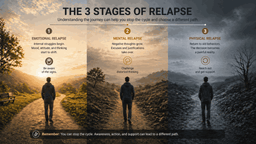
The 3 Stages of Relapse Explained
Most addiction specialists agree that relapse unfolds in three distinct stages. This model was pioneered by psychologist Dr. Steven Gorski and is now widely used in treatment programs across the country, including those in Los Angeles and throughout California. Recognizing these stages of relapse early gives you the best chance of getting back on track before a full physical return to substance use occurs.
Emotional Relapse: Early Warning Signs
In emotional relapse, you are not yet thinking about using. But your emotions and behaviors are laying the groundwork for what may come. This is the earliest — and most preventable — stage.
Common relapse warning signs at this stage include:
• Bottling up emotions instead of expressing them
• Skipping support group meetings (such as AA or NA)
• Poor self-care: not sleeping, skipping meals, or isolating
• Increased anxiety, irritability, or mood swings
• Returning to “all-or-nothing” thinking patterns
• Feeling like you don’t need help anymore
At this point, the key is not to “white-knuckle” your way through. It’s to practice self-care and ask for help early. Many Los Angeles-based treatment centers offer ongoing outpatient support precisely for moments like this.
Mental Relapse: Internal Conflict and Cravings
In mental relapse, a mental tug-of-war begins. Part of you wants to stay sober. Another part starts romanticizing past use. This is when signs of relapse become more urgent and harder to ignore.
Mental relapse warning signs include:
• Craving drugs or alcohol for the first time in a while
• Thinking about people, places, or things associated with past use
• Minimizing the consequences of previous substance use
• Bargaining: “I’ll only use on weekends” or “Just once won’t hurt”
• Planning a relapse while keeping it secret from others
• Fantasizing about using substances
The longer someone stays in mental relapse without intervention, the harder it becomes to resist. This is why relapse prevention strategies must be practiced consistently — not just when things feel hard.
Physical Relapse: Returning to Substance Use
Physical relapse is what most people picture when they hear the word: the moment of actually using a substance again. For alcohol relapse, this might mean taking that first drink. For opioid use disorder, it may mean using again after a period of abstinence.
Physical relapse often happens in two phases:
1. The initial use (the “slip”)
2. A full return to previous patterns of use (if intervention is not swift)
If physical relapse occurs, it is critical to seek help immediately — do not wait. The risk of overdose is especially high after a period of abstinence because the body’s tolerance has dropped significantly. This is a medical emergency, not a moral failure.
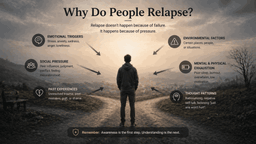
Why Do People Relapse?
Understanding why do people relapse is essential to preventing it. Relapse rarely has a single cause. It is typically the result of multiple overlapping factors.
Biological Factors
Addiction changes the brain’s reward circuitry. Even after months or years of sobriety, certain triggers can activate powerful cravings. Genetics also play a role — some people are biologically more vulnerable to substance use disorders, as noted by the Centers for Disease Control and Prevention (CDC).
Psychological Triggers
Mental health conditions and addiction often go hand in hand. Anxiety, depression, PTSD, and other disorders can dramatically increase relapse risk. This is known as a co-occurring disorder, or
dual diagnosis, and it requires specialized treatment that addresses both conditions simultaneously.
Environmental and Social Triggers
People, places, and things associated with past use can trigger powerful cravings. In cities like Los Angeles, where social pressures and access to substances can be ever-present, building a sober-supportive environment is crucial.
Common environmental triggers include:
• Returning to old neighborhoods or hangout spots
• Reconnecting with people who still use
• High-stress situations at work or at home
• Holidays, anniversaries, or emotional milestones
Overconfidence in Recovery
Sometimes people relapse because they start to believe they no longer need support. This is sometimes called “recovery complacency,” and it is one of the most common precursors to the cycle of relapse beginning again.
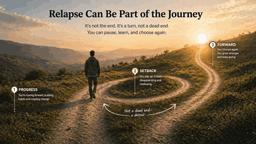
Is Relapse Always a Part of Recovery?
Relapse is common — but it is not inevitable. Nor does it mean that treatment has failed or that long-term recovery is impossible.
Relapse is more common than most people realize. Research shows that relapse rates for substance use disorders — somewhere between 40% and 60% — are actually comparable to other chronic conditions like hypertension or asthma (Witkiewitz & Marlatt, Addiction). That puts things in perspective. Relapse isn’t a sign of weakness or poor character — it’s part of a medical reality.
What matters most is what to do when an alcoholic relapses or when anyone in recovery has a setback: respond quickly, with compassion, and with professional support.
In California, the Department of Health Care Services (DHCS) has invested in expanding access to recovery support services precisely because relapse prevention — not just detox — is central to long-term success.

How to Prevent Relapse
Knowing the stages of relapse is only the first step. The next step is building a concrete, personalized relapse prevention plan. Here are evidence-based approaches that work.
Build a Strong Support Network
Research consistently shows that social support is one of the strongest predictors of long-term sobriety. Regular attendance at 12-step programs (like AA or NA), SMART Recovery groups, or other peer support communities significantly reduces relapse risk.
Identify Your Personal Triggers
Work with a therapist or counselor to map out your unique relapse triggers — the specific people, places, emotions, and situations that increase your vulnerability. Then create a concrete plan for how to respond to each one.
Practice the HALT Method
A simple but powerful tool: before a craving escalates, ask yourself whether you are:
- Hungry
- Angry
- Lonely
- Tired
Addressing these basic needs can interrupt the emotional relapse stage before it gains momentum.
Develop a Crisis Plan
Have a written plan for what you will do if you experience intense cravings or a slip. Include emergency contacts, your sponsor’s number, and the address of your nearest treatment center.
Maintain Structure and Routine
Unstructured time is a significant relapse risk factor. Filling your schedule with meaningful activities — work, exercise, hobbies, volunteering — keeps your mind occupied and your sense of purpose strong.


Relapse Prevention Techniques Used in Treatment
Professional treatment programs use several evidence-based approaches to help people identify warning signs and build long-term coping skills.
Cognitive Behavioral Therapy (CBT)
CBT is considered a gold-standard approach in addiction treatment. It helps you identify and change the thought patterns that lead to substance use. In CBT, you learn to recognize cognitive distortions — such as “I can’t cope without using” — and replace them with healthier thoughts and behaviors.
A 2019 meta-analysis published in the Journal of Substance Abuse Treatment found that CBT significantly reduced relapse rates compared to standard care alone.
Mindfulness and Stress Management Techniques
Mindfulness-Based Relapse Prevention (MBRP) is an approach that teaches you to observe cravings without acting on them. Studies published in the journal Substance Use & Misuse suggest that MBRP can reduce the frequency and intensity of cravings over time.
Practical tools include:
• Deep breathing and grounding exercises
• Regular meditation practice
• Yoga or mindful movement
• Journaling to process emotions
Medication-Assisted Treatment (MAT)
Medication-Assisted Treatment (MAT) combines FDA-approved medications with counseling and behavioral therapies. For opioid use disorder, medications like buprenorphine and naltrexone have been shown to cut relapse risk significantly. For alcohol addiction treatment, medications like acamprosate and naltrexone can reduce cravings and the rewarding effects of alcohol.
MAT is not “replacing one drug with another.” It is evidence-based medicine, endorsed by SAMHSA, the CDC, and WHO.
Family Therapy and Education
Addiction affects the whole family. Involving loved ones in therapy helps repair relationships, reduce enabling behaviors, and create a supportive home environment. Programs like Al-Anon and Nar-Anon help family members develop their own coping strategies


Finding the Right Support for Long-Term Recovery
What works for one person may fall completely flat for another. Your past experiences, any underlying mental health concerns, and what you actually want your life to look like — all of it shapes the kind of help that will genuinely move the needle. For a lot of people, having real structure around them, day in and day out, is what finally makes sobriety stick.
If you or someone close to you is ready to take that step, The House of Life offers a highly personalised luxury rehab experience in Los Angeles. Treatment here isn’t pulled from a generic playbook, it’s built around you, delivered by licensed professionals, and grounded in approaches that research actually backs: cognitive behavioral therapy, medication-assisted treatment, and care that accounts for trauma rather than ignoring it. The goal isn’t just getting through the day sober. It’s building something worth staying present for.
Stages of Relapse: FAQ
What Is a Relapse Cycle?
What Are the Four Stages of Relapse?
What Are the 5 Stages of Recovery?
Disclaimer: This article is intended for educational and informational purposes only. It does not constitute medical advice, diagnosis, or treatment. If you or someone you know is struggling with substance use, please consult a licensed healthcare professional.
Reference
Kitzinger et al. (2023). Habits and Routines of Adults in Early Recovery From Substance Use Disorder.. https://pubmed.ncbi.nlm.nih.gov/36798446/#:~:text=Abstract,as%20research%20suggestions%2C%20are%20outlined.
MacKillop J. (2020). Is Addiction Really a Chronic Relapsing Disorder? Alcohol Clin Exp Res.https://pmc.ncbi.nlm.nih.gov/articles/PMC7739524/
Melemis SM. (2015). Relapse Prevention and the Five Rules of Recovery. Yale J Biol Med.https://www.ncbi.nlm.nih.gov/pmc/articles/PMC4553654/