Table of Contents
- What Is Court-Mandated Rehab?
- How Court-Ordered Rehab Works in California
- Who Is Eligible for Court-Ordered Rehab
- How to Find Court-Ordered Rehab Near Me in California
- Types of Court-Ordered Rehab
- Who Pays for Court-Ordered Rehab?
- How Long Does Court-Ordered Rehab Last?
- Factors Influencing the Duration of Court-Ordered Rehab
- Is Court-Ordered Rehab Effective?
- What Happens If I Do Not Complete Court-Ordered Rehab?
- How to Avoid Violations in Court-Ordered Rehab in California
- Benefits of Completing Court-Mandated Rehab
- How The House of Life Can Help?
- Sources
When substance use contributes to a criminal case, California courts may require treatment instead of relying only on jail, fines, or standard probation. In practice, court ordered rehab can be part of a drug court, a DUI case, probation, or another collaborative justice program. California’s Judicial Branch describes these courts as evidence-based and reports that collaborative justice courts operate in all but two small counties statewide.
This matters in California because addiction remains both a public health and legal issue. In Los Angeles County, drug-related overdose and poisoning deaths fell from 3,137 in 2023 to 2,438 in 2024, but county officials still describe overdose as a major crisis. That is one reason courts continue to use treatment-based interventions for eligible people whose substance use is tied to criminal behavior.

What Is Court-Mandated Rehab?
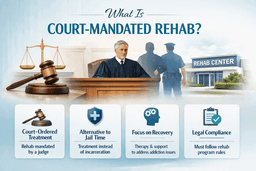
Court mandated rehab is addiction treatment that a judge orders or makes a condition of a legal outcome. A person may be required to attend counseling, complete residential or outpatient treatment, submit to drug testing, appear in court regularly, and follow strict program rules.
In California, court ordered treatment does not follow one single model. It may be connected to a DUI conviction, a collaborative drug court, or probation terms that require treatment and progress monitoring.
How Court-Ordered Rehab Works in California
The process usually starts with screening and assessment. The court or supervising team reviews the charge, the person’s substance use history, public safety factors, and treatment needs before deciding whether treatment is appropriate. In some cases, this process may overlap with what is commonly referred to as involuntary rehab in California, where treatment is mandated rather than voluntarily chosen.
If accepted, the person is placed into a treatment plan that may include detox or withdrawal management, outpatient care, residential treatment, medication for addiction treatment, counseling, drug testing, and regular status reviews with the court. California’s Drug Medi-Cal Organized Delivery System, or DMC-ODS, was built to provide an evidence-based continuum of care using ASAM placement standards.
Who Is Eligible for Court-Ordered Rehab
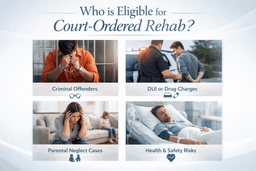
Eligibility depends on the offense, the county, the person’s treatment needs, and the program available. Courts typically look at whether substance use contributed to the case and whether a treatment-based response can protect public safety while addressing addiction.
People with nonviolent drug-related offenses, repeated DUI issues, probation violations tied to substance use, or a strong clinical need for treatment may be candidates. Some serious or violent cases may be excluded, and local court resources also affect who is admitted.

How to Find Court-Ordered Rehab Near Me in California
If someone is searching for court ordered rehab, the safest place to start is with official California resources, not random online listings. The California Department of Health Care Services maintains substance use treatment directories and county access points to help people find licensed and certified programs.
In most cases, your first step should be speaking with the court, your attorney, probation officer, or your county’s behavioral health access line. These sources can direct you to programs that meet legal requirements. It’s also important to choose the right level of care. Some individuals may qualify for outpatient programs, while others may be required to enter a more structured setting, such as a residential treatment facility.
Types of Court-Ordered Rehab
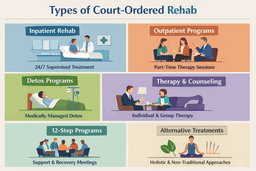
There is no single format for court ordered rehab. The right setting depends on the person’s clinical severity, relapse risk, legal obligations, and whether the court expects community-based treatment or a more structured placement.
Detox or Withdrawal Management
Some people need detox or withdrawal management before they can fully participate in treatment. This is especially important when alcohol, benzodiazepine, or opioid withdrawal may create medical risks.
Outpatient Treatment
Outpatient care allows a person to live at home while attending therapy, education, and drug testing. This level is often used when the court wants accountability but the individual does not need 24-hour supervision.
Residential Treatment
Residential care provides a more structured environment with daily support and monitoring. It may be appropriate when relapse risk is high, the home environment is unstable, or the person needs more intensive care than outpatient treatment can provide.
DUI Programs
California has state-licensed DUI programs with defined durations. DHCS states that a first DUI offense generally requires a 3-month program, a first offense with a blood alcohol content of 0.20 or higher requires a 9-month program, and repeat offenders often complete 18-month or 30-month programs.
Medication for Addiction Treatment
For opioid use disorder especially, medication can be a key part of recovery. California’s treatment system includes medication-based services within its substance use treatment continuum.
Who Pays for Court-Ordered Rehab?
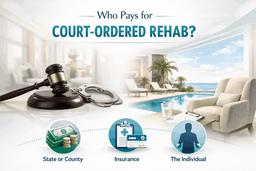
The answer to who pays for court-ordered rehab depends on insurance, Medi-Cal eligibility, county funding, and the type of program ordered. A court can require treatment, but that does not automatically mean all treatment costs are covered.
For many Californians, Medi-Cal is the main funding route. DMC-ODS was designed to expand access to substance use disorder services for Medicaid-eligible individuals and now operates in 40 counties covering 97.3% of California’s population.
Private insurance and self-pay are also common, especially for people seeking more specialized or premium settings such as luxury rehab programs. Even when treatment is covered, people may still face costs such as transportation, testing, or DUI-related program fees. California also allows some DUI participants to request financial assessments and reduced fee arrangements.
How Long Does Court-Ordered Rehab Last?
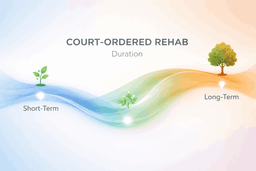
The question how long is court ordered rehab does not have one universal answer. The duration depends on the legal program, the level of care, progress in treatment, and whether the case is tied to DUI, probation, or a collaborative court model.
Common Durations
For DUI cases in California, program lengths are often clearly defined. A first DUI offense usually means 3 months, some first offenses require 9 months, and repeat offenders may face 18- or 30-month programs.
Outside DUI cases, residential treatment often lasts 30, 60, or 90 days, while outpatient supervision may continue for several months. This is why the answer to the question “how long is court ordered rehab?” can vary depending on the court order and treatment plan. Federal addiction guidance from NIDA also notes that many people need at least 3 months of treatment to significantly reduce or stop drug use.
Factors Influencing the Duration of Court-Ordered Rehab
Severity of addiction is one of the biggest factors. A person with repeated relapse, opioid or methamphetamine use disorder, unstable housing, or co-occurring mental health problems may need longer care than someone with a first-time alcohol-related case.
Compliance also matters. Missed drug tests, absences, rule violations, or relapse may lead to more monitoring, extended treatment, or delayed graduation from the program.

Is Court-Ordered Rehab Effective?
Court ordered rehab can be effective when it combines treatment with accountability. California’s courts describe collaborative justice models as evidence-based, and DMC-ODS was specifically created to expand access to evidence-based substance use treatment.
State evaluation data suggest that DMC-ODS increased the number of clients receiving funded services by 16% since inception and that client ratings of treatment have remained consistently high. That does not mean every case succeeds, but it does support treatment as a serious alternative to punishment alone.
What Happens If I Do Not Complete Court-Ordered Rehab?
Failing to complete court mandated rehab can create legal consequences. The exact result depends on whether the person was in drug court, probation, DUI court, or another program, but repeated noncompliance can lead to sanctions or removal from the program.
This is also the practical answer to what happens if you leave court-ordered rehab. Leaving without approval may be treated not just as a treatment setback, but as a violation of a court order, which can bring the person back to sentencing, probation penalties, or prosecution.
How to Avoid Violations in Court-Ordered Rehab in California
The best approach is to treat the program as both medical care and a legal obligation. Attend every required appointment, drug test, court hearing, and counseling session unless you have documented approval to miss it.
Communication is critical. If housing, transportation, medical issues, or the assigned treatment level is becoming a problem, tell your lawyer, probation officer, or treatment team immediately. That is far safer than trying to disappear or searching online for how to get out of court-ordered rehab without formal court approval.
Benefits of Completing Court-Mandated Rehab
Completing treatment can improve both legal and personal outcomes. Courts may respond more favorably when a person follows through with treatment, and successful completion can reduce the risk of relapse, overdose, and future legal problems.
For many people, it also creates a path toward stability, employment, family repair, and long-term recovery. For anyone asking will going to rehab help in court, the answer is often yes when participation is genuine, documented, and complete.
How The House of Life Can Help?
Navigating court-ordered rehab requirements can feel overwhelming, especially when deadlines, compliance rules, and treatment expectations are involved. At House of Life, we help individuals and families find treatment options that align with court requirements while also supporting long-term recovery.
Our team can guide you through the process, from understanding your court mandate to identifying appropriate levels of care, whether that includes outpatient services, residential treatment, or medication-assisted treatment. We also work with a range of insurance plans and offer self-pay options to make treatment more accessible.
If you or a loved one needs help finding court-approved rehab in California, contact us for confidential guidance and next steps.
Court-Ordered Rehab: FAQ
Can You Get Out of Court-Ordered Rehab Early?
What Is the Average Length of Stay in Rehab?
How Successful Is Court-Ordered Rehab?
Do You Have to Pay for Rehab if It’s Court Ordered?
What Is the Hardest Drug to Quit?
What Is the 60% Rule in Rehab?
Sources
Judicial Council of California. Collaborative Justice Courts Fact Sheet (Updated March 2025).
https://courts.ca.gov/system/files/file/collaborativcourts_factsheet.pdf
Use this for California collaborative justice courts, eligibility variation, statewide availability, and program structure.
California Department of Health Care Services. Driving-Under-the-Influence Programs.
https://www.dhcs.ca.gov/individuals/Pages/DUI_Programs.aspx
Use this for California DUI program durations, including 3-month, 9-month, 18-month, and 30-month programs.
California Department of Health Care Services. DUI Program Fees.
https://www.dhcs.ca.gov/individuals/Pages/DUI-Program-Fees.aspx
Use this for financial assessments, reduced fees, $5-per-month maximum fee eligibility, and extended payment plans for some DUI participants.
California Department of Health Care Services. CalAIM 1115 Interim Evaluation Report for DMC-ODS with CM.
https://www.dhcs.ca.gov/provgovpart/Documents/CalAIM-1115-Interim-Evaluation-Report-for-DMC-ODS-with-CM.pdf
Use this for Drug Medi-Cal Organized Delivery System coverage, evidence-based continuum of care, statewide reach, and access data.
County of Los Angeles. Public Health Reports Most Significant Decline in Drug-Related Overdose Deaths in LA County History (June 25, 2025).
https://lacounty.gov/2025/06/25/public-health-reports-most-significant-decline-in-drug-related-overdose-deaths-in-la-county-history/
Use this for Los Angeles County overdose and poisoning death statistics.National Institute on Drug Abuse. Principles of Drug Addiction Treatment: A Research-Based Guide (Third Edition).
https://nida.nih.gov/sites/default/files/podat-3rdEd-508.pdf
Use this for the statement that many people need at least 3 months of treatment to significantly reduce or stop drug use.