Table of Contents
- Can You Drink Alcohol While Taking Ibuprofen?
- What Happens When You Mix Ibuprofen and Alcohol? Risks and Side Effects
- How Much Alcohol Is Dangerous With Ibuprofen?
- How Long After Taking Ibuprofen Can You Drink Alcohol?
- What to Do If You Mixed Ibuprofen and Alcohol
- Are There Any Pain Medications Not Affected by Alcohol?
- Reference
Ibuprofen is one of the widely used medications people use daily for a wide range of symptoms, including headache. It is estimated that 22.3% of the U.S. population uses ibuprofen, making it the second most common over-the-counter medication. Alcohol, on the other hand, is a part of social life, especially in Los Angeles, California.
Many people tend to use them both as they seem to be harmless. However, the combination of mixing ibuprofen and alcohol poses danger for our health and has its side effects. In this article we will cover everything from A to Z, and discover what the use of those two together can cause.


Can You Drink Alcohol While Taking Ibuprofen?
Technically, drinking alcohol while taking ibuprofen is not always an emergency situation. In fact, the moderate amount of alcohol is considered as a low-risk for adults. The actual risk can increase depending on how much you consume, in what frequency, and whether you have any underlying health conditions.
Ibuprofen, belongs to a class of drug that works by blocking specific enzymes that signal pain while protecting the lining of the stomach. In the same way, alcohol irritates the stomach lining, and increases acid production. Combining these two together can be risky since you are depleting stomach protection while attacking it.
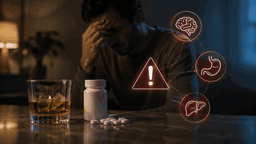
What Happens When You Mix Ibuprofen and Alcohol? Risks and Side Effects
Combining ibuprofen and alcohol does not produce one single effect , but rather it triggers a range of responses across various organs. While some of these can develop over time with repeated use of those, others can show up immediately right after. Let’s cover the immediate risks and side effects of using them together.
Risks of Mixing Ibuprofen and Alcohol
Gastrointestinal Bleeding: According to a study conducted by American Journal of Gastroenterology, heavy use of ibuprofen and alcohol use together can significantly increase the risk of upper gastrointestinal bleeding. Keep in mind that this issue, if arisen, requires immediate care.
Kidney Damage: Both of them stress the kidney – one reducing blood flow to the kidneys, the other causing dehydration. Using these two substances together can decrease kidney filtration rates, which may have its long-term consequences,particularly chronic kidney damage or acute kidney failure.
Reduced Effectiveness of Ibuprofen: If used together, medication may not work the same way as expected. Research shows that taking ibuprofen with alcohol reduces peak blood concentrations of the drug from approximately 17.9 micrograms per milliliter down to around 13 micrograms per millilite.
Side Effects of Mixing Ibupofen and Alcohol
Stomach Pain and Nausea: Both substances irritate the stomach on their own, causing nausea, cramping, or an unsettled stomach.
Dizziness and Drowsiness: Separately, both of these substances cause mild sedation. If taken together, they can cause drowsiness and dizziness.
Impaired Coordination and Reaction: Alcohol’s effect on motor functions is not a eureka. Adding ibuprofen to the max can increase these effects, causing falls or accidents.
Rapid Heartbeat and Flushing: Some people experience a flushed feeling, elevated heart rate, or a sensation of warmth when mixing the two. This is more common in individuals who are sensitive to either substance, and in those who consume alcohol quickly alongside ibuprofen.
How Much Alcohol Is Dangerous With Ibuprofen?
There is no universally defined threshold for taking these two substances together. However, much research suggests that moderate amounts of alcohol consumption carries relatively low risk when combined with ibuprofen.
The risk immediately increases with heavy drinking or higher doses of ibuprofen. Standard OTC ibuprofen’s dose is 200 to 400mg, while with prescription it can run up to 800mg. The higher the dose, the more dangerous it becomes, when mixed with alcohol.

How Long After Taking Ibuprofen Can You Drink Alcohol?
How long after taking ibuprofen can you drink alcohol is one of the most commonly searched questions on this topic, and the answer lies in basic pharma. This means that its concentration decreases by half for every two hours.
Most healthcare suggests waiting for roughly 10 hours for the complete elimination of the drug from your body. If you are using standard doses of 200 to 400mg of ibuprofen, then 10 to 12 should be sufficient. However, if you are drinking ibuprofen with a prescription with doses of 600 to 800mg, it is highly recommended to wait for at least 17 hours before drinking alcohol, especially if impaired with liver or kidney functions. .
NOTE: If it is in the reverse direction, and you have already drunk alcohol, you should wait for at least 24 hours, since alcohol remains in your system for up to 24 hours.

What to Do If You Mixed Ibuprofen and Alcohol
If you have already mixed them, but feel fine, then you are not in an immediate danger. You should seek medical attention, if you experience one or more of the following symptoms:
- Starry or black stool
- Abdominal pain
- Dizziness
- Difficulty breathing
- Jaundice
- Swelling in the hands, feet, or ankles
If you are a heavy drinker, and regularly mix those two together, consult with your doctor to mitigate the risk for serious issues, such as liver damage. Additionally, if your concern is the alcohol itself and you feel it is gradually becoming an addiction, seeking professional alcohol addiction treatment can provide the support, medical care, and long-term recovery strategies needed to regain control of your health.
Are There Any Pain Medications Not Affected by Alcohol?
Not all pain relievers interact with alcohol in the same way. It depends on various factors, such as the type of medication, how it is metabolized, and how much alcohol is involved.
Ibuprofen vs Tylenol With Alcohol
Does ibuprofen interact with alcohol differently than Tylenol?
Yes, it does. The primary risk for mixing alcohol and ibuprofen is mainly gastrointestinal, and it can include stomach bleeding, kidney stress, or ulcers. On the other hand, tylenol, when mixed with alcohol, targets specifically the liver.
Mixing alcohol with ibuprofen puts the entire organ system under risk, while combining tylenol with alcohol affects only one organ.
Which Pain Relievers Should Be Avoided?
All types of NSAIDs, including aspirin, naproxen, , and even Advil and alcohol combinations carry serious risk when drinking. Aspirin, for example, significantly increases the risk of GI bleeding even at low doses when combined with alcohol.
If you are dealing with chronic pain while also consuming alcohol, consult with your doctor or pharmacist, and learn about the potential risks for the specific pain reliever you are using.
If you find that you’re regularly mixing alcohol with pain medication and struggling to cut back, that’s worth paying attention to. Speaking with a doctor is a good first step, and for some people, a structured treatment program can make a real difference. You can learn more about what that looks like [here].
If you’re frequently relying on pain relievers while drinking, it may be worth taking a closer look at your relationship with alcohol. Over time, regular use can take a toll on your body in ways that go beyond the immediate risks of mixing substances. For those ready to make a change, a luxury rehab in Los Angeles like The House of Life can provide the medical support and space to start that process safely.

Mixing Ibuprofen and Alcohol: FAQ
How Long Does Ibuprofen Stay in Your System?
Can Ibuprofen and Alcohol Damage Your Liver?
Can I Take Ibuprofen 1 Hour Before Drinking?
How Much Ibuprofen Can I Take if I Plan to Drink?
Reference
Green, J. L., Dailey-Govoni, T., Kalidindi, S. D., & Vosburg, S. K. (2026). Prevalence of over-the-counter and prescription medication use in the US. JAMA Network Open, 9(2), e2559479. https://jamanetwork.com/journals/jamanetworkopen/fullarticle/2845129
Kaufman, D. W., Kelly, J. P., Wiholm, B. E., Laszlo, A., Sheehan, J. E., Koff, R. S., & Shapiro, S. (1999). The risk of acute major upper gastrointestinal bleeding among users of aspirin and ibuprofen at various levels of alcohol consumption. American Journal of Gastroenterology, 94(11), 3189–3196. https://journals.lww.com/ajg/abstract/1999/11000/the_risk_of_acute_major_upper_gastrointestinal.24.aspx