Table of Contents
- Does Cocaine Make You Sweat?
- Why Does Cocaine Make You Sweat?
- What Do Cocaine Sweats Look and Feel Like?
- Cocaine Sweats During the Comedown
- Cocaine Sweats and Other Cocaine Side Effects
- When Are Cocaine Sweats a Sign of an Emergency?
- How Long Do Cocaine Sweats Last?
- What to Do If Someone Is Sweating After Using Cocaine
- Treatment for Cocaine Addiction in Los Angeles, CA
- References
Sweating is one of the more visible and clinically significant physical signs of cocaine use, and also one of the more misunderstood. Most explanations stop at “cocaine speeds up your nervous system,” which is true but incomplete. The more clinically important part is that cocaine doesn’t just cause sweating, it also interferes with the body’s ability to cool itself when it needs to most. That distinction matters, since it’s part of why cocaine-related deaths rise sharply during hot weather.
This guide covers the physiology behind cocaine sweats, how they present at different stages of use, and when sweating stops being a nuisance and becomes a medical emergency.
Does Cocaine Make You Sweat?
Yes. Does cocaine make you sweat? Reliably, and often heavily, in the majority of users. Diaphoresis, the clinical term for profuse sweating, is one of the core signs clinicians look for when assessing acute cocaine intoxication, alongside tachycardia (a resting heart rate typically above 100 beats per minute), hypertension, and dilated pupils. Sweating tends to appear within minutes of use, particularly with insufflation (snorting) or smoking, since both routes produce a rapid rise in circulating catecholamines. It’s not limited to the acute high either. Sweating can reappear hours later during the comedown, and again during withdrawal in people who use it regularly.
For someone trying to make sense of a friend or family member’s symptoms, sweating paired with agitation, a racing pulse, and dilated pupils is a recognizable clinical pattern, not a vague collection of unrelated complaints. If you’ve come across unfamiliar terms while trying to identify what someone actually used, our page on slang for cocaine can help translate street terminology into something more concrete.

Why Does Cocaine Make You Sweat?
Why cocaine makes you sweat comes down to its effect on the sympathetic nervous system, the “fight or flight” circuitry that governs heart rate, blood pressure, and thermoregulation. Cocaine blocks the reuptake of dopamine, norepinephrine, and serotonin at the synapse, flooding the body with these neurotransmitters. Because eccrine sweat glands are innervated by sympathetic cholinergic fibers, this catecholamine surge drives sweat production directly.
There’s a second, less intuitive part of the mechanism, and it’s arguably the more medically important one. A controlled human study published in the Annals of Internal Medicine gave healthy volunteers a 2 mg/kg dose of intranasal cocaine, compared against intranasal lidocaine as a control, then subjected both groups to progressive heat stress while measuring core temperature, skin blood flow, and sweat rate. Cocaine shifted the temperature threshold for vasodilation upward, from 37.06°C with lidocaine to 37.37°C with cocaine, and did the same for sweating onset, from 37.07°C to 37.38°C (Crandall et al., 2002). In practical terms, cocaine delays the exact protective responses the body relies on to shed heat, while also blunting subjects’ perception of heat itself.
The combination of increased heat production and a delayed cooling response is now considered a major mechanism behind cocaine-associated hyperthermia, and it helps explain why cocaine-related mortality rises substantially in hot weather, disproportionate to what stimulant effects on metabolism alone would predict.
What Do Cocaine Sweats Look and Feel Like?
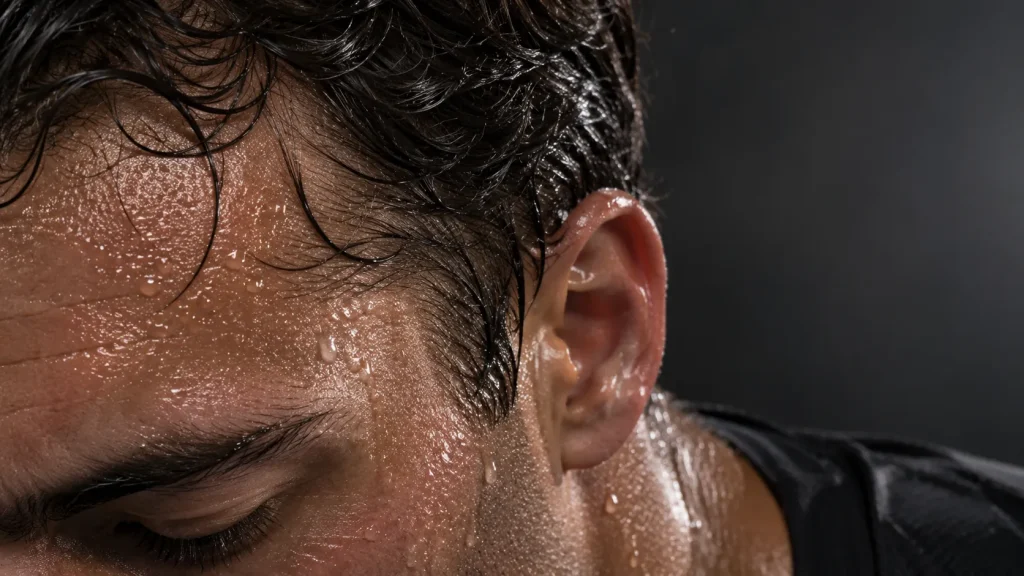
Cocaine sweats tend to feel sudden and out of proportion to the surrounding environment. People often describe a flush of heat through the chest, neck, and face, clammy palms, and sweat breaking out even in a cool room. It’s typically accompanied by a heart rate well above resting baseline, restlessness, and a subjective sense of being overheated that, per the Crandall findings above, may not correspond accurately to actual core temperature.
Cocaine Night Sweats
Cocaine night sweats occur when sympathetic activation persists well past the point where the subjective high has faded. Cocaine’s plasma half-life is short, roughly 0.7 to 1.5 hours, but its active metabolite norcocaine can linger longer than the euphoric effects themselves. Someone might fall asleep hours after use and wake up drenched, sometimes more than once, as the body continues processing elevated heart rate and residual catecholamine activity.

Cocaine Sweats During the Comedown
Sweating doesn’t necessarily stop when the euphoric effects wear off. During the comedown, the body is recalibrating after intense sympathetic overdrive, and sweating, chills, and temperature instability are common parts of that process. This phase overlaps closely with what’s often described as a cocaine hangover, which typically includes fatigue, irritability, and continued physical discomfort well into the next day.

Cocaine Sweats and Other Cocaine Side Effects
Sweating rarely presents in isolation. It’s usually one part of a broader sympathomimetic toxidrome that includes tachycardia, elevated blood pressure (often above 140 mmHg systolic), dilated pupils, and agitation. Cocaine sweats combined with this cluster gives clinicians a far more reliable read on active use than any single symptom on its own.
Cocaine isn’t the only substance that produces this picture. When people ask what drug makes you sweat a lot, other stimulants, particularly methamphetamine and MDMA, rank near the top, since all three trigger a comparable sympathetic surge. Anyone in Los Angeles noticing this pattern regularly should consider a formal clinical evaluation at a luxury rehab in Los Angeles rather than attributing it to heat, exercise, or anxiety.
When Are Cocaine Sweats a Sign of an Emergency?
Understanding does cocaine make you sweat in a way that signals genuine danger, rather than ordinary discomfort, is the most clinically important distinction in this article.
Most cocaine-related sweating, while uncomfortable, isn’t dangerous on its own. It becomes a medical emergency when paired with a rapidly rising body temperature, confusion, chest pain, seizures, or a sudden absence of sweating despite obvious overheating, since that can indicate the body has lost its ability to thermoregulate entirely. Core temperatures above 103°F warrant urgent evaluation, and temperatures climbing toward 106°F carry substantially elevated risk of organ damage and death.
Does cocaine make you hot enough to become life-threatening on its own?
Yes. Severe hyperthermia from cocaine toxicity is a well-documented cause of death, and given the mechanism above, the risk climbs in hot, crowded environments like festivals, nightclubs, or outdoor events. This requires immediate emergency care rather than a wait-and-see approach. For anyone whose use has reached a point where these symptoms occur regularly, our cocaine detox in Los Angeles program provides medical stabilization under direct clinical supervision.

How Long Do Cocaine Sweats Last?
Acute sweating is usually associated with the short half-life of cocaine and decreases over one to two hours as the drug’s peak effects subside. Sweating and nite sweats associated with comedown can last much longer than that window, sometimes into the next day, especially after larger or repeated doses within a single session. A single episode just fading is more consistent with someone who uses regularly and has a withdrawal pattern of sweating that lasts for several days and occurs with anxiety, low mood, or strong drug cravings.

What to Do If Someone Is Sweating After Using Cocaine
Move the person to a cooler environment and keep them hydrated, since cocaine’s impairment of temperature regulation means overheating can escalate faster than expected, especially in a hot or crowded setting. Monitor closely for confusion, chest pain, seizures, or skin that feels alarmingly hot to the touch. If any of these appear, call 911 immediately rather than waiting for symptoms to resolve on their own. Loosen tight clothing, keep the person as calm as possible, and don’t leave them alone until they’re clearly stable or emergency responders have arrived.

Treatment for Cocaine Addiction in Los Angeles, CA
Cocaine remains a persistent factor in Los Angeles County’s overdose landscape, and the county’s warm climate and active nightlife scene add a genuine layer of risk given how directly cocaine interferes with heat regulation. County Department of Public Health data shows cocaine involved in roughly 17% of accidental drug overdose deaths in recent years, a share that has stayed fairly consistent even as fentanyl and methamphetamine figures have shifted (Los Angeles County Department of Public Health, 2025).
At The House of Life, our clinical team regularly evaluates patients presenting with cocaine-related autonomic symptoms, including sweating and temperature instability, as part of intake and medical stabilization. In our experience, families often underestimate how quickly sweating paired with agitation can progress toward a genuine emergency, which is why this symptom cluster gets flagged early rather than treated as incidental. Our cocaine addiction treatment Los Angeles program addresses both the physical and psychological dimensions of dependence.
References
Crandall, C. G., Vongpatanasin, W., & Victor, R. G. (2002). Mechanism of cocaine-induced hyperthermia in humans. Annals of Internal Medicine, 136(11), 785-791. Retrieved July 27, 2026, from https://www.acpjournals.org/doi/10.7326/0003-4819-136-11-200206040-00006
Los Angeles County Department of Public Health, Substance Abuse Prevention and Control. (2025, September). Report on drug overdoses in Los Angeles County. Retrieved July 27, 2026, from http://publichealth.lacounty.gov/sapc/MDU/SpecialReport/Report-on-Drug-Overdoses-in-Los-Angeles-County.pdf
StatPearls. (2025, February 16). Sympathomimetic toxicity. National Center for Biotechnology Information. Retrieved July 27, 2026, from https://www.ncbi.nlm.nih.gov/books/NBK430757/