


Table of Contents
- What Is a High Functioning Alcoholic?
- High-Functioning vs. Non-High-Functioning Alcoholism
- Common Signs of a High Functioning Alcoholic
- Why High Functioning Alcoholism Is Difficult to Recognize
- The Hidden Risks of High Functioning Alcoholism
- When Does Social Drinking Become a Problem?
- Treatment Options for High Functioning Alcoholism
- How to Help Someone Who May Be a High Functioning Alcoholic
Most people picture an alcoholic as someone who has visibly lost control of their life, unable to hold a job, estranged from family, or clearly intoxicated in public. But a large, overlooked population tells a very different story. The signs of a high functioning alcoholic are subtle, frequently hidden behind professional success, social charm, and a seemingly stable life.
Recognizing these signs isn’t just important for the individual—it can be lifesaving for the people around them. This guide covers everything you need to know, from early warning signs to treatment options.


What Is a High Functioning Alcoholic?
A high functioning alcoholic is someone who meets the clinical criteria for alcohol use disorder, signs, symptoms and treatment (AUD) yet continues to maintain a relatively normal, sometimes impressive, outward life. They may hold senior positions at work, raise children, participate in community activities, and appear perfectly composed to friends and colleagues.
The term “high functioning” does not mean their drinking is safe or under control. It simply means the consequences are not yet visible to the outside world.
The definition of a functioning alcoholic centers on a key paradox: dependent on alcohol, but without the catastrophic fallout typically associated with addiction. They rationalize drinking as a stress reliever, a reward, or simply part of a social lifestyle.
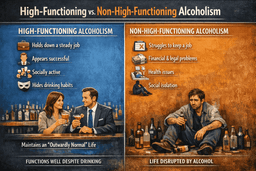
High-Functioning vs. Non-High-Functioning Alcoholism
| Factor | High-Functioning | Non-High-Functioning |
| Employment | Typically employed, often successful | Frequent job loss |
| Relationships | Strained but intact | Often broken |
| Appearance | Well-kept, professional | Visible deterioration |
| Self-awareness | Often in denial | May acknowledge problem |
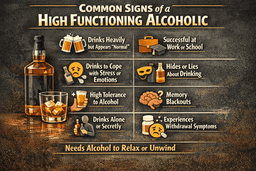
Common Signs of a High Functioning Alcoholic
Identifying the signs of a high functioning alcoholic requires looking beyond the surface. These are the key behavioral indicators:
- Drinking to cope with stress or emotions: Alcohol becomes the default response to every emotional state—stress, celebration, boredom. Rather than an occasional indulgence, it’s their primary coping mechanism, and they feel genuinely unable to manage without it.
- Inability to stop at one or two drinks: One of the clearest traits of an alcoholic is losing control once drinking starts. They may sincerely plan to have two drinks and consistently end up having six or more. This inability to moderate is a hallmark of dependency.
- Blackouts and memory gaps: Waking up with no memory of conversations, calls, or decisions made the night before is a serious red flag—and a sign of significant alcohol dependency.
- Irritability or anxiety when not drinking: Visible anxiety, irritability, or shakiness when alcohol isn’t available signals physical dependency and withdrawal. Shaking after drinking alcohol is one of the most recognizable signs that the body has become physically dependent.
- Denial and minimization: The most consistent characteristic of a functioning alcoholic is insisting there’s no problem. They use their career success and intact family life as evidence that their drinking can’t possibly be out of control.
- Neglecting responsibilities after drinking: Despite appearing functional, they may consistently miss morning appointments, arrive late after a night of drinking, or forget commitments scheduled after their usual drinking window.
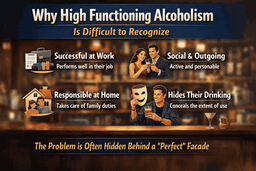
Why High Functioning Alcoholism Is Difficult to Recognize
Cultural normalization of heavy drinking makes this hard to spot. In many professional circles, heavy drinking is not just accepted—it’s celebrated at business dinners, conferences, and happy hours. When it’s the norm in someone’s environment, it becomes nearly impossible to see where social drinking ends and dependency begins.
High-functioning alcoholics have also learned to manage their image expertly—scheduling drinking around responsibilities, crafting believable explanations for concerning behavior, and using professional achievements as a shield against scrutiny. Friends and family often enable this unknowingly, covering for them, making excuses, or convincing themselves that someone so successful couldn’t possibly have a real problem.
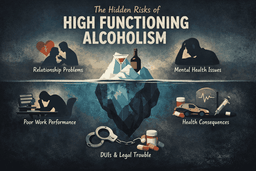
The Hidden Risks of High Functioning Alcoholism
A high-functioning alcoholic who looks fine on the outside is still accumulating serious internal damage. Physical risks include liver disease (fatty liver, hepatitis, cirrhosis), increased risk of mouth, throat, and liver cancers, cardiovascular problems, pancreatitis, and long-term neurological decline. Mental health consequences include worsening anxiety and depression—alcohol is a depressant that amplifies both. Social fallout includes relationship breakdown, sudden DUIs, financial instability from the mounting cost of heavy drinking, and deepening isolation. The damage builds silently until it becomes impossible to ignore.
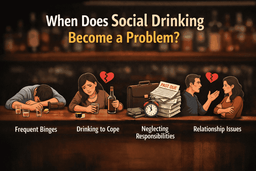
When Does Social Drinking Become a Problem?
A common question is: how many drinks a week is considered an alcoholic? The NIAAA defines heavy drinking as more than 14 drinks per week for men and more than 7 for women, or more than 4 drinks on any single day (men) or 3 (women). But quantity alone doesn’t determine a problem—the more important question is control. Can they stop when they want to? Is alcohol causing harm to their health, relationships, or work? Are they unable to cut back despite trying? These warning signs matter far more than raw numbers.
Treatment Options for High Functioning Alcoholism
Recovery isn’t one-size-fits-all—and the best treatment programs are built around that reality. Here’s what a well-rounded program typically offers:
- Alcohol detox: Before any real therapeutic work can begin, the body needs to be stabilized. For heavy drinkers, stopping suddenly isn’t just uncomfortable—it can be dangerous. Medically supervised alcohol detox manages withdrawal safely, monitors for serious complications like seizures, and gets the person to a place where they’re physically ready to engage with treatment.
- Individual therapy: This is where the real work happens. A therapist works with the person one-on-one to understand what’s been driving the drinking—whether that’s stress, trauma, anxiety, or something they’ve never said out loud. It’s not generic; it’s built around their specific history, and it’s where patterns start to actually shift.
- Group therapy: Comes in a few different forms. Some sessions are educational—learning about addiction, triggers, and what recovery actually looks like. Others are more open, where people talk through what they’re feeling with others who get it. And some are activity-based, using hands-on experiences to get at things that are harder to put into words.
- Mindfulness and relaxation: For someone who spent years using alcohol to switch off, learning to decompress without it is one of the hardest adjustments. Meditation, yoga, and breathwork give people practical tools to sit with stress rather than escape it—skills that matter long after treatment ends.
- Art and music therapy: Not everyone processes things by talking. Creative therapies open up a different channel—especially useful for working through trauma or grief that’s been buried for a long time.
- Horticultural therapy: There’s something grounding about growing things. Tending a garden builds patience, routine, and a quiet sense of accomplishment—small but meaningful things to rebuild during recovery.
- Recreational and sports therapy: Pickleball, basketball, volleyball, golf—physical activity does a lot of the heavy lifting that people don’t expect. It rebuilds structure, burns off anxiety, and reminds people what it feels like to be in their body without alcohol.
- Wellness therapies: Dry sauna, cold plunge, jacuzzi, swimming pool. Chronic drinking takes a serious physical toll, and these aren’t just perks—they help the body reset, reduce cortisol, and restore sleep and energy in ways that support the emotional work happening alongside them.
- Nature-based therapy: Getting outside—walks, gardening, landscape work—has a real effect on mood and mental clarity that’s hard to replicate indoors. It’s a simple intervention with consistently strong results.
- Outpatient programs (IOP/PHP): Not everyone can step away for 30 or 90 days. Intensive outpatient and partial hospitalization programs give people access to structured, serious treatment while staying at home and managing their responsibilities.
- Support groups: AA, SMART Recovery, and similar communities matter most after the formal treatment ends. They fill the gap that even the best program can’t fully cover—the ongoing, day-to-day accountability that makes the difference between short-term sobriety and lasting recovery.
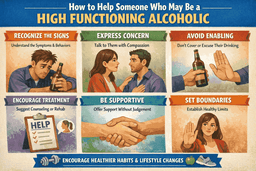
How to Help Someone Who May Be a High Functioning Alcoholic
Knowing how to help a functioning alcoholic starts with accepting you can’t force recovery, you can only create conditions for it. Here’s how:
- Choose the right moment: Talk when they are sober and calm, in private.
- Use “I” statements: “I’m worried about you” opens dialogue. “You have a problem” shuts it down.
- Be specific: Cite real incidents rather than vague concerns.
- Set firm boundaries: Avoid enabling—covering for them or making excuses slows recovery.
- Come prepared: Research treatment options in advance so you’re ready when they are.
- Take care of yourself: Al-Anon exists specifically for family and friends of people with AUD.
The signs of a high functioning alcoholic are easy to miss—everything on the surface looks fine. But the internal damage is real and accumulating. Recognizing the signs of a high functioning alcoholic in yourself or someone you love is the critical first step. Recovery is possible, and no level of success needs to be sacrificed to get well.
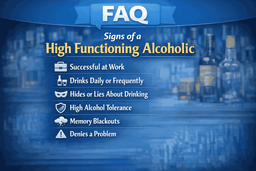
FAQ: Signs of a High Functioning Alcoholic
What Are the Characteristics of a Functioning Alcoholic?
What Is Stage 4 Alcoholism?
Does a High-Functioning Alcoholic Drink Every Day?
How Many Drinks a Week Is Considered an Alcoholic?
What Is the One Symptom That All Alcoholics Have In Common?
How to Help a Functioning Alcoholic?
References
Maharjan S, Amjad Z, Abaza A, Vasavada AM, Sadhu A, Valencia C, Fatima H, Nwankwo I, Anam M, Mohammed L. Executive Dysfunction in Patients With Alcohol Use Disorder: A Systematic Review. Cureus. 2022 Sep 15;14(9):e29207. doi: 10.7759/cureus.29207. PMID: 36258974; PMCID: PMC9573267.
National Institute on Alcohol Abuse and Alcoholism. “Researchers Identify Alcoholic Subtypes” (Press release). National Institutes of Health.
Wechsler H, Nelson TF. What we have learned from the Harvard School Of Public Health College Alcohol Study: focusing attention on college student alcohol consumption and the environmental conditions that promote it. J Stud Alcohol Drugs. 2008 Jul;69(4):481-90. doi: 10.15288/jsad.2008.69.481. PMID: 18612562.


