


Table of Contents
- Teen Slang: What Does “Crossfaded” Mean?
- What Happens When a Person Gets Cross-Faded?
- Why People Combine Drugs
- Dangers of Cross-Fading: Why People Shouldn’t Mix Alcohol and Marijuana
- Other Commonly Used Drugs To Get Cross-Faded
- Recognizing the Signs of Crossfaded Behavior
- Treatment Options for Substance Use at The House of Life
Party culture has its own vocabulary, and few terms have spread as quickly among young people as “cross-faded.” But beyond the slang, there is a serious medical story worth understanding. The cross faded meaning is straightforward: it describes the state of being simultaneously drunk from alcohol and high from marijuana. What is far less straightforward, and far more concerning, is what that combination actually does to the human body.
Teen Slang: What Does “Crossfaded” Mean?
Slang for cocaine and alcohol evolves fast, and substance-related terms are no exception. If a teenager or young adult in your life has used the word “crossfaded” and you weren’t sure what to make of it, you’re not alone. The term is a mashup of “crossed” — meaning under the influence of more than one substance, and “faded” simply means intoxicated, high, drunk, or otherwise out of it. It has been part of hip-hop and youth culture vocabulary for decades, and it carries a generally casual, even positive connotation that obscures the underlying risk. Knowing what does faded mean in drugs culture is useful for anyone trying to have informed conversations with young people about substance use. The term “crossfaded” has become especially visible on TikTok, Instagram, and Twitter, where videos and posts casually document the experience.


What Happens When a Person Gets Cross-Faded?
When alcohol and marijuana enter the body at the same time, the effects do not simply stack on top of each other, they interact in ways that are often more intense and more unpredictable than either substance alone. Understanding that interaction is key to grasping why cross-fading carries real medical risk.
How Alcohol and THC Interact in the Body
Alcohol is a central nervous system (CNS) depressant. It amplifies the activity of gamma-aminobutyric acid (GABA), an inhibitory neurotransmitter, while reducing the activity of glutamate. The result is slowed brain function, impaired coordination, lowered inhibitions, and at high doses, suppressed breathing. Marijuana’s primary psychoactive compound, delta-9-tetrahydrocannabinol (THC), acts on the endocannabinoid system, binding to CB1 receptors concentrated in the brain. Effects include altered perception, euphoria, slowed reaction time, elevated heart rate, and in some individuals, anxiety or paranoia.
High vs. Drunk: How Being Cross-Faded Feels Different
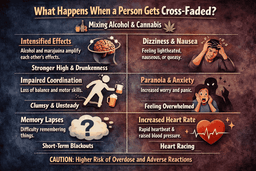
Most people who have tried both substances separately understand the difference between being high on weed and being drunk on alcohol, the two states have distinct qualities. But combining them creates something that veterans of both experiences often describe as qualitatively different from either. The weed and alcohol high vs drunk comparison breaks down when you’re cross-faded: the effects blend, amplify, and become less predictable than either substance produces on its own. Common experiences include:
• Intense dizziness or a spinning sensation
• Nausea and a high likelihood of vomiting (what people call “greening out”)
• Heightened anxiety, panic, or paranoia
• Severely impaired balance and coordination
• Disorganized thinking and difficulty holding a conversation
• Rapid or irregular heartbeat (tachycardia)
• Heavy sedation, or in serious cases, loss of consciousness
The “Greening Out” Phenomenon
One of the most unpleasant and well-documented consequences of being drunk and high at the same time is what users call “greening out,” a sudden, overwhelming wave of nausea, dizziness, sweating, and pallor that can result in fainting. It tends to happen more often when alcohol is consumed first: the lowered inhibitions lead a person to smoke more marijuana than they normally would, while the physiological effect of alcohol simultaneously increases THC absorption. The result can go from fun to frightening very quickly.
The Crossfaded Hangover
The crossfaded hangover often involves prolonged fatigue, persistent nausea, cognitive fog, headache, and low mood that can stretch through most of the following day. Both alcohol and marijuana disrupt sleep architecture, particularly REM sleep, leaving people feeling unrested even after a long night, and compounding the other symptoms.
Why People Combine Drugs
Poly-substance use doesn’t happen in a vacuum. Understanding the motivations behind cross-fading is essential for prevention, early intervention, and treatment.
Social and Cultural Norms
At parties, festivals, and casual social gatherings, both alcohol and marijuana are often simultaneously available and socially accepted, especially as cannabis legalization expands across the United States. Many people combine them simply because both are on offer and their social environment normalizes doing so. Peer influence is a powerful driver, particularly among adolescents and young adults whose sense of identity and belonging is strongly tied to group behavior.
Chasing a Stronger Effect
Some people deliberately combine alcohol and marijuana because they’ve heard the cross faded experience is more intense than either substance alone. It’s a fair question whether being cross faded is fun: some people do report heightened euphoria, especially in low doses and relaxed settings. But the margin between “enjoyable” and “overwhelming” is narrow and highly individual, and first-time or inexperienced users frequently find the experience tipping into anxiety, nausea, or panic without warning.
Self-Medication and Coping
A meaningful portion of people who use multiple substances together are doing so to manage something: chronic pain, anxiety, insomnia, depression, trauma, or social discomfort. While alcohol and marijuana may provide temporary relief from these experiences, regular co-use tends to worsen the underlying conditions over time and substantially increases the risk of dependence.
Dangers of Cross-Fading: Why People Shouldn’t Mix Alcohol and Marijuana
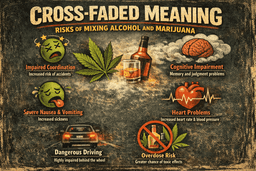
The risks of cross-fading go well beyond a bad night. Both in the short term and over time, combining alcohol and marijuana creates a health risk profile that is more serious than either substance presents on its own.
Impaired Driving and Accident Risk
Impaired driving is one of the most immediate and serious dangers of being cross-faded. The National Highway Traffic Safety Administration (NHTSA) has documented that both alcohol and marijuana impair driving independently, but the combination is not simply additive. People who feel “okay to drive” after combining the two substances are frequently far more impaired than they realize, because the subjective sense of impairment does not keep pace with the objective loss of function.
Increased Risk of Alcohol Poisoning
Marijuana is a well-established anti-emetic, meaning it suppresses nausea and the urge to vomit. In medical settings, this property is actually valuable (it’s used in chemotherapy patients, for instance). But in the context of cross-fading, it removes a critical safety mechanism. Vomiting is the body’s way of expelling excess alcohol before it can be fully absorbed. When marijuana suppresses that reflex, a person who has drunk a dangerous amount of alcohol loses that protective response and faces a substantially higher risk of alcohol poisoning.
Mental Health Consequences
Regular co-use of alcohol and marijuana is associated with significantly worse mental health outcomes than either substance alone. Both independently elevate the risk of anxiety and depression.
Escalation to Other Substances
Combining substances is one of the more reliable predictors of escalating to harder drugs. People who regularly cross-fade are at elevated statistical risk of eventually experimenting with cocaine, opioids, benzodiazepines, or other substances.
Other Commonly Used Drugs To Get Cross-Faded
While alcohol and marijuana are the most commonly combined substances, the term “cross-faded” is sometimes applied more loosely to any simultaneous multi-drug experience. Several other combinations are particularly worth knowing about because of how frequently they appear in clinical and emergency settings.
Alcohol and benzodiazepines (such as Xanax or Valium) are both CNS depressants, and their combination is among the most medically dangerous pairings known. The synergistic suppression of the central nervous system dramatically elevates the risk of respiratory failure and overdose death.
Alcohol and cocaine produce a third compound in the liver called cocaethylene, which is more cardiotoxic than either drug alone and extends the duration of cocaine’s effects while placing sustained stress on the heart. For anyone struggling with this combination, detoxing from cocaine under medical supervision is a necessary first step.
Alcohol and MDMA is a pairing common at concerts and nightclubs. MDMA’s stimulant properties mask alcohol’s sedative effects, leading users to drink far more than they recognize. The combination dramatically increases dehydration and the risk of alcohol poisoning.
Recognizing the Signs of Crossfaded Behavior
Being able to identify when someone is cross-faded, rather than simply drunk or simply high, matters in a practical sense. Physical signs include extreme difficulty walking or standing, glassy and heavily bloodshot eyes, pale or greenish skin, cold sweating, persistent nausea or vomiting, and slurred speech. The combination of marijuana’s slowed, heavy-limbed sedation with alcohol’s flushing, emotional volatility, and smell creates a presentation that is recognizably different from either substance alone. Behaviorally, watch for rapid mood swings (flipping between laughter and distress), paranoid statements, an inability to track a basic conversation, highly impaired judgment, and in serious cases, slipping in and out of consciousness.
Treatment Options for Substance Use at The House of Life
Recognizing a problem is the hardest step, and if you’re reading this, you may already be there.
At The House of Life, we provide individualized, evidence-based care for people navigating alcohol dependence, marijuana use disorder, or complex poly-substance use.
For those physically dependent on alcohol, medically supervised alcohol detox is the safest starting point. Alcohol withdrawal can progress to serious medical complications, including seizures and delirium tremens, which is why attempting to stop drinking without clinical support is not recommended for anyone with significant alcohol dependence.
Our alcohol and cocaine addiction treatment approach integrates cognitive-behavioral therapy (CBT), motivational interviewing, trauma-informed care, family therapy, and aftercare planning. We treat the whole person, not just the substance, because lasting recovery depends on addressing the emotional and psychological factors that drive use, not just the physical ones.
Our clinical team has deep experience with complex cases, and we meet every person where they are without judgment.
If you or someone you love is ready to take the next step, we are here.
Cross-Faded Meaning: FAQ
What Does Cross Faded Mean in Slang?
What Is Another Word for Cross Faded?
What Does a Crossfade Look Like?
How Do I Know if I Have Drank Too Much Alcohol?
How Do I Know if I Have Smoked Too Much Weed?
How Do You Stop Throwing up When Cross-Faded?
Can You Have One or Two Alcoholic Drinks With Marijuana?
References
Patrick ME, Lee CM. Cross-faded: Young Adults’ Language of Being Simultaneously Drunk and High. Cannabis. 2018;1(2):60-65. doi: 10.26828/cannabis.2018.02.006. Epub 2018 Jul 7. PMID: 30643908; PMCID: PMC6329594.
Levine, H. (2024, September 9). REM sleep: What is it, why is it important, and how can you get more of it? Harvard Health Publishing. https://www.health.harvard.edu/staying-healthy/rem-sleep-what-is-it-why-is-it-important-and-how-can-you-get-more-of-it


