


Table of Contents
- What Is Involuntary Rehab?
- Can You Force Someone Into Rehab in California?
- The Legal Framework Behind Voluntary vs. Involuntary Rehab in California
- Who Can Request Involuntary Rehab?
- The Process of Involuntary Commitment in California
- How Long Can Someone Be Held in Involuntary Treatment?
- Is Involuntary Rehab Effective?
- Alternatives To Forcing Someone into Rehab In California
- Getting Help for Substance Use in California
Watching someone you love struggle with addiction, and refuse help, is one of the most painful experiences a family can face. Eventually, a desperate question arises: can you force someone into rehab in California? The short answer is yes, under specific legal conditions. But the process is more complicated than many people expect, and it isn’t guaranteed to produce lasting recovery. Here is what you actually need to know.
What Is Involuntary Rehab?
Involuntary rehab, also called involuntary commitment or compulsory treatment, means placing someone into a substance use or mental health treatment program without their consent. Unlike voluntary treatment, this is initiated through a legal process involving law enforcement, clinicians, or the courts. The goal is to stabilize individuals who pose an immediate danger to themselves or others, or who are too impaired to meet their own basic needs.
Can You Force Someone Into Rehab in California?
Yes, but not simply because you believe they need help. California does not have a direct equivalent to Florida’s Marchman Act, which allows family members to petition a court specifically for involuntary substance abuse assessment. However, the state does have several legal tools that can result in involuntary treatment, and recent legislation has significantly expanded those tools.
The most widely used pathway is the 5150 hold under the Lanterman-Petris-Short (LPS) Act, which allows law enforcement or a mental health professional to place someone in a psychiatric hold for up to 72 hours without consent. Forcing someone into rehab in California beyond that initial hold requires additional legal steps — but they exist.

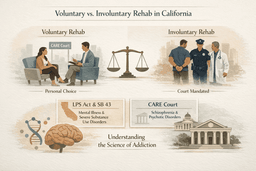
The Legal Framework Behind Voluntary vs. Involuntary Rehab in California
California’s involuntary commitment laws are governed primarily by the Lanterman-Petris-Short (LPS) Act. For decades, the definition of “gravely disabled” applied only to people who couldn’t care for themselves due to a mental health disorder. That changed with Senate Bill 43, signed in 2023 and effective January 1, 2024, which expanded the definition to include severe substance use disorders. Early-adopter counties like San Francisco implemented it in 2024; all remaining California counties were required to comply by January 1, 2026, making this the most significant update to commitment law in over 50 years.
California also launched the CARE Court program (Community Assistance, Recovery, and Empowerment Act), now active in all 58 counties. It’s important to understand what CARE Court does — and doesn’t — cover. CARE Court is specifically designed for individuals with schizophrenia spectrum or other psychotic disorders (and bipolar I with psychotic features as of 2026). It does not apply to standalone substance use disorder without a qualifying psychotic diagnosis. That said, it can be relevant when a loved one has a co-occurring condition. For those wondering whether addiction is a disease or a choice, understanding the science also shapes how courts and clinicians approach these cases.
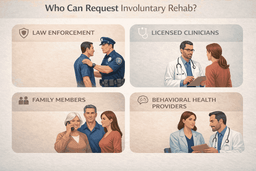
Who Can Request Involuntary Rehab?
- Law enforcement — Police can initiate a 5150 hold if someone appears dangerous or gravely disabled.
- Licensed clinicians — Psychiatrists and licensed mental health professionals can place a hold or refer for conservatorship evaluation.
- Family members — While families cannot place a 5150 hold directly, they can call 911, contact a crisis line, or file a CARE Court petition.
- Behavioral health providers — Treatment providers may petition for extended involuntary care if the individual meets legal criteria.
The Process of Involuntary Commitment in California
5150 Hold (72 hours): A peace officer or clinician places the individual in a psychiatric hold for evaluation at a crisis stabilization unit.
5250 Hold (up to 14 days): If the person still meets the criteria after 72 hours, they can be certified for up to 14 additional days of intensive treatment, with a hearing.
Extended 30-Day Holds: With court approval, two additional 30-day intensive treatment periods are available under the LPS Act as updated by SB 43.
Conservatorship: For the most severe and chronic cases, a court may appoint a conservator to make treatment decisions on the person’s behalf on an ongoing basis.
If you are researching how to get a loved one into rehab through the courts, your county’s behavioral health department or a licensed behavioral health attorney can walk you through the petition process specific to your area.
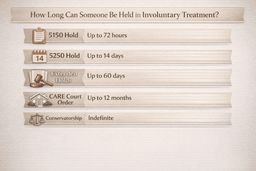
How Long Can Someone Be Held in Involuntary Treatment?
- 5150 hold: Up to 72 hours
- 5250 hold: Up to 14 days
- CARE Court order: Up to 12 months of supervised outpatient treatment
- Conservatorship: Ongoing, reviewed periodically by the court
A rehab center can not keep you against your will beyond these timeframes. Facilities operating within California law must follow these legally defined holds and cannot detain anyone beyond what a court has authorized.
Is Involuntary Rehab Effective?
Involuntary interventions for substance use disorders are less effective and potentially more harmful than voluntary treatment, and involuntary centers often serve as venues for abuse.
While legally coerced treatment, such as that offered by drug courts as an alternative to incarceration, has mixed evidence, compulsory treatment has not been shown to improve health.
Past involuntary treatment was associated with a nearly two-fold increase in the odds of non-fatal overdose. Forced abstinence during incarceration places individuals at extremely high risk of overdose after release by decreasing tolerance without treating substance use disorders.
These centers employ widely varying approaches, at best offering counseling and education of unproven efficacy and at worst subjecting detainees to forced labor and other human rights violations. What most involuntary centers have in common is the failure to provide evidence-based treatment for substance use disorders. The continued existence of these practices may be driven less by evidence than by ideology, stigma, and limited access to voluntary treatment.
Scaling up voluntary, evidence-based, low-barrier treatment options might invalidate the perceived necessity of involuntary interventions, and could go a long way toward reducing the risk of overdose associated with untreated or inappropriately treated substance use disorders.
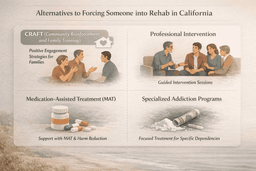
Alternatives To Forcing Someone into Rehab In California
Before pursuing involuntary commitment, consider these evidence-based approaches that often prove more effective at building long-term engagement:
- CRAFT (Community Reinforcement and Family Training): Teaches families how to use positive reinforcement to encourage treatment entry without confrontation — and has strong research behind it.
- Professional Intervention: A trained interventionist facilitates a structured, compassionate conversation between the person and their loved ones.
- Medication-Assisted Treatment (MAT): For someone not yet ready for full sobriety, MAT and harm reduction strategies reduce immediate danger while the door stays open.
For specific dependencies like stimulants, specialized programs also make a real difference — a cocaine addiction treatment program, for example, is designed around the unique psychological dynamics of stimulant use disorder.

Getting Help for Substance Use in California
If you’ve been researching how to get someone into rehab, you probably need support too. Caring for someone in active addiction is exhausting and isolating — don’t wait for a crisis to reach out.
California offers a full continuum of care, from detox to long-term residential support. A structured residential treatment program provides 24-hour clinical support in a setting removed from triggers, while The House of Life, combines evidence-based treatment with a private, comfortable environment designed for sustained healing.
For free, confidential referrals available 24/7, call us at +1 805 888 8000.
Forcing someone into luxury rehab in California is legally possible — but it is rarely the whole answer. The law provides tools to create safety and opportunity. What fills that space is treatment, support, and ultimately, the person’s own will to heal. If you’re navigating this situation, professional guidance makes all the difference. You don’t have to do this alone.
References:
Bazazi AR. Commentary on Rafful et al. (2018): Unpacking involuntary interventions for people who use drugs. Addiction. 2018 Jun;113(6):1064-1065. doi: 10.1111/add.14202. PMID: 29732697; PMCID: PMC7006027.
California Welfare and Institutions Code § 5150 (2022). https://leginfo.legislature.ca.gov/faces/codes_displaySection.xhtml?lawCode=WIC§ionNum=5150 Department of Mental Health. (2024). CARE Court information and resources. Los Angeles County. Retrieved March 22, 2026, from https://dmh.lacounty.gov/court-programs/care-court/


